Showing posts with label book review. Show all posts

Wednesday, January 29, 2020

Audio Book Review, "The Haunting of Hill House"


Review in Brief
The book, "The Haunting of Hill House" is not good.

The Plot Goeth Thusly
            In order to study supernatural phenomenon a psychiatrist gathers a group of people for a study in a haunted house.  The main viewpoint character of Eleanor slowly goes mad in the house as supernatural shit keeps happening.

My First Complaint: Boring
The book is boring.  I cannot fault the prose of the work, as the words have a descriptive power and flow that is nice, the performer allows the words to trip off their tongue quite eloquently.  But the plot drags and there is just not enough meat to the story.  By "meat" I mean revelations, there are few if any twists or surprises, these people are in a haunted house with some architectural quirks (that I am sure are metaphors) and they get spooked by ghosts.
            I guess I was expecting more of a “And Then There Were None” type situation, where the characters clash with one another, all have secrets and ultimately they unravel as the situation spirals out of control.  But aside from several instances of ghosts causing noise and everyone being afraid the vast majority of the book is the main character, Eleanor’s internal monologue which vacillates between demure and bitchy.

My Next Complaint: The Main Character
Eleanor is such a hard protagonist to root for.  The implication in the novel is that she starts out as a good-natured shrinking violet who has had little love in her life and the house sort of twists her insecurities into general bitchiness and ultimately self-destruction.  But, her dialogue is boring, and she is a boring person. At some point you need the viewpoint character of your book to have more of a personality than feckless human chew toy.  I don’t know, I got no vibes of internal struggle, just a steady descent from pathetic to miserable, and ultimately back to pathetic.  Not so much a character arc as a character boomerang.
            How would I have fixed this?  Simple, I would have had more characters.
            For a book where the premise is, “Psychiatrist conducts a study,” the Doctor has a comically small pool of participants.  Seriously, there are two people involved in the study, demure Eleanor and the free-spirited Theodora.  There is another guy there, Luke who is a member of the family that owns the house, but he’s not part of the study.  Beyond that there are some extremely tertiary characters, the Doctor’s wife (who is a sort of proto Gwyneth Paltrow for her use of bullshit in the study) and her… bodyguard(?) Arthur who mostly serves as a gruff salt of the earth contrast to the rest of the cast.  And I guess the rude house help… But fuck’em, their whole personalities begin and end with them being curt to the guests.

Just to sidetrack a moment, I am not going to watch this show.
Calling this nonsense a "lab" is such horse shit that I feel insulted on behalf of science.
Netflix should be ashamed.

None of the other characters work.  The Doctor comes off to me as a doddering old fool with no real method to the study that forms the impetus for the story.  Theodora has traits but mostly exists as a foil for Eleanor, and her establishing section of the novel paints her as so flighty and detached that she effectively has no motivation.  Luke is just a swaggering dick and offers no conflict to the story (we are told he is a liar and a cad... But it never amounts to anything in the narrative.  How about having him act that way?), mostly he just spends all of his time pouring drinks and playing chess with the Doctor (seriously, that is how a large chunk of his time on page is spent).  Then the Doctor’s hen-pecking idiot wife shows up with her servant(?) Arthur, a dull-witted thug.  Give me someone to care about, and then have that person clash with characters who I also care about.
            Overall there is just a lack of inter character drama and a lack of layers for the cast.  Eleanor is the focus, sure it is good to have a core character, but there is no mystery element, no one is more/less/something other than they appear to be, at least not in a way that comes up in the story or impacts the plot.  It is odd to have characters that all have dimension and contrast with one another just fine… But nothing really comes of it.

Why I Got This Book
I got this on sale for Halloween and because the "Inspired by" limited series on Netflix was so good.  How such a great Netflix series was inspired by it is like the evolutionary steps that moved from especially smart monkeys up to Humans, you can see how it happened, but is such a significant change that you have to marvel at it.
"Hey, what if the Ghosts were metaphors for something and we could couple the aftermath of living in the house with the events as they happened to create a mystery that the audience will feel engaged unraveling?"  "That sounds like a great idea!"


Ultimate Conclusion
            I wouldn’t recommend this even for people interested in the horror canon.  There are just better books out there.  If you want supernatural horror, listen to “Dracula”, and if you are looking for an ensemble piece set in a spooky house then go with the previously mentioned, “And Then There Were None” (which is not perfect, but it is better than this).
            “The Haunting of Hill House” fails with the supreme kiss of death for any work of fiction, the 8 deadly words, “I don’t care what happens to these people.”

______________________________
            If you like or hate this please take the time to comment, share on Twitter (click that link to follow me), Tumblr, or Facebook, and otherwise distribute my opinion to the world.  I would appreciate it.

Thursday, December 19, 2019

Audio Book Review, "The Scribbly Man"

TLDR: It Sucks

Prologue
            To start off this discussion I want to first talk about another book that is more interesting than this one, “Sheepfarmer's Daughter” by Elizabeth Moon, in her fantasy saga, “The Deed of Paksenarrion”.  I read that book ages ago and for all that time I was trying to get my thoughts about it down on paper.  I would start, get bogged down, start talking about the Hero’s Journey and how character arcs are supposed to work… Then I would stop and throw it all out.
            There was too much to talk about with “Sheepfarmer's Daughter”.  I wrote other massive book reviews for the other murderer’s row “Worst books I have managed to finish”, a strange subgenre of things I tell people to stay away from.  There was my review of “Year One” which I again mention “Sheepfarmer's Daughter”.  And my review of the boring as fuck “Genesis”, a review that I am kind of proud of.  But I was still not able to hammer out all the things I wanted to get into with the first “Deed of Paksenarrion” book.
            There are other things that I feel almost obligated to write about one day to explain in excruciating detail why I dislike them so much, but I don’t feel so bad about Elizabeth Moon’s book now, because something new has taken the laurel as the worst book I have ever managed to finish, Terry Goodkind’s “The Scribbly Man”.

Introduction
I came into reading this aware of Terry Goodkind's status as a prolific writer who helped define the fantasy genre over the decades... I expected this to be good.
Let me start with the first of many complaints, this is not a "Book 1" it is the direct continuation of an earlier series, events from that previous series define the main view point characters, the world, and serve as the inciting action for this story.  I got this assuming it was the author building a new series from the ground up, it is not, and the lack of clear upfront explanation of things makes the material surprisingly obtuse.  What is more, and this only matters to fans of his work (and there is a horde, this thing is intensely well reviewed) the book is comically short, it would be a quarter of a typical fantasy novel, even one meant to start a series.
 
For reference, this book (which I still hate) is 15 hours and 48 minutes.
"Scribbly Man" is 3 hours and 50 minutes.
The Plot
            The King and his wife who is sort of the Pope of a fantasy world are confronted by someone telling them that a “Golden Goddess” is coming to conquer their planet.  This guy is carted off for interrogation and a Witch shows up to be a new character (her presence should be a big red flag to everyone else… and somehow they treat her like they’ve known her for years).
            Turns out the guy in the interrogation tried to kill the Pope with the help of the titular “Scribbly Man” a monster from another world as a herald of the Golden Goddess.  The Pope lives, and together with the other characters they later resolve to fight the bad guy… And that is it.  Shockingly short book, I would not have stuck it out if it were longer.

Some Complaints
My initial and core complaints about this title have to do with the comically bad writing.  Dialogue is so stilted that the voice actor seems to have no idea how to deliver the lines, halting, flat, and repetitive.  I swear to god, the number of times the word "Gift" or "Witch Woman" show up in some chapters the words start to lose all meaning.  And of course "Scribbly Man" and "Golden Goddess" which are repeated dozens of times to the point where you just want to shake them and say, call one of them "They" or "Gary" or something else so that I can stop rolling my eyes at how overly formal you are all being.
And everything has such boring nomenclature.  "War Wizard" "Sword of Truth" "Confessor" "Witch Woman", they all feel like place holders that you put into the script until you can think of something distinct or punchy to give the world flavor like "Fremen" in Dune, “Istari” in Lord of the Rings, or “Jedi” in Star Wars.  “Scribbly” lacks sophistication with the writing terminology and that makes it feel flat.  I don’t need a whole fictional language or whatever, but come up with something more interesting sounding that “War Wizard”.
 
Tank Mage would have at least been a cool visual.
But he is just the 10,000th fantasy jerk off with a sword.
Some More Complaints
The plotting makes little sense too, there is a part where the heroes all decide to interrogate a villain, so they walk into a cell and then they stop and have a 10-minute private conversation that they all could have had in another room.  It is like the chapter is in the wrong place.  Same goes for lots of cuts to the action.  A chapter ends with the Confessor in complete control of a situation, zero tension, and then when we come back the villain has stabbed her, and an unseen monster has viciously attacked her.  What?  You were fine?  Why didn’t the last chapter we saw you in end with a violent attack?
There is also just a lack of characters.  There are 2 main, 2 supporting, and 3 minor in a book about a fantasy kingdom being invaded by incorporeal mind controlling ghost monsters from the stars.  Where is the war council?  Where are prominent heroes, intellectuals, and advisers outside of the two heroes and the random "Witch Woman" who happens to show up the same day as the evil ghosts... and for some reason no one treats that as massively suspicious.
There is the real twist that needed to happen, the “Witch Woman” should have been concocting the whole alien invasion thing to put her in a position to harm the two main heroes… She even has motivation to do so… not that it makes any sense because it was the conclusion to the last series of books, but the Witch doesn’t seem to take, “Sorry I screwed up the source of one of your many super powers… But I literally was thwarting the end of life on this planet.  You should probably just get over it.”

"Sure, the dead would have walked the earth...
But you would have gotten to keep your ability to tell people's fortunes.  Idiot."

Some More Complaints
Also, the heroes are assholes.  One of them uses magic to completely enslave the will of a person who is already brainwashed by the villain and she is so pissed of at him for telling her that the bad guys are coming she kills him… Like he was a victim of the monsters.  And what is more that scene has another hero brutally and casually mutilate the guy to break the villain’s control over him, it is unpleasant and shocking… and the main heroes are just like, “Ha!  I’m starting to like her!”  Which is gross.
Another small thing, the title is stupid.  This is the start of the series and while “Scribbly Man” is said to the point where the words boarder on meaningless it is not technically the main threat, the “Golden Goddess” is.  And what is more there is some asinine argument between the two main characters about how one promised the other a “Golden Age” and she is mad at him because she is now conflating “Golden Age” and “Golden Goddess” in a train of logic I could not follow.  The book, which takes place as a SEQUEL to the past series should have been called “The Golden Age” to show the contrast between the promise of the main hero and the looming threat of the villain, you know, the parallel he was trying to establish and failed to.

A Backhanded Compliment
To switch gears, I will give it one credit.  The idea of the shimmering ghost like entity, the titular Scribbly Man is a good image.  The way its tracks are described, the idea that it has claws and venom, that it is especially alien and sees causing fear and killing akin to sexual pleasure.  They are a fitting threat to the protagonists who are the undisputed supreme monarchs of an entire planet with magic powers and seemingly limitless resources… Yeesh… way to write identifiable characters am I right?  Guess that isn’t a lot of credit there…

This is from the show... Which is... Shockingly bad.
Also, gotta love that old trope of superior bloodlines making them magically awesome
Conclusion
Note: I did not pay full price for this, I got it for $1.99 and still thought about returning it.  Overall, this is garbage.  The sort of flat clunky mess that I would expect as the first fantasy novel hacked out by a 15-year-old.  Made all the more disappointing because it is apparently the work of a rock star in the genre.  Baffling.

______________________________
            If you like or hate this please take the time to comment, share on Twitter (click that link to follow me), Tumblr, or Facebook, and otherwise distribute my opinion to the world.  I would appreciate it.

Monday, September 10, 2018

Audible Review, "Genesis"


Introduction
I recently finished another boring book that had strange pacing problems, it was “Genesis” by Ken Lozito and narrated by Scott Aeillo.  It is book one in the “First Colony” series.  I got it on sale from Audible as I am a frequent reader of science fiction.

It sucked...


The Plot
            After a botched military black operation against the international criminal organization known as “The Syndicate” results in the death of millions, Colonel Conner is kidnapped by his commanding officer and put onto the first ever interstellar colony ship.  Conner will be made the fall guy for the botched op but will be allowed to live in exile on some distant alien world.
            After arriving Conner quickly ingratiates himself with the comically inept colonists by telling them incredibly basic tactics and saving people from their own stupidity.  He becomes head of his own search and rescue team and after a short period of time spent in the role manages to save people from a horde of slavering monsters.
            Then, rather than offer any sort of denouement, the last 30 minutes of the story is a massive sequel hook to a book I will never read.

The voice actor did his bestwith the material he was given.
           
First: Some Good Stuff
            This book has a lot of good set up.  A main character with a dark past fighting terrorists and criminals; hundreds of thousands of colonists in suspended animation means that the author will never run out of new and interesting characters that need no explanation for why they haven’t been around; and there are mysteries on the planet, with alien ruins and monsters that promise adventure in a pulp science fiction sense.
            The action scenes are pretty good.  I have a good understanding of the geography of each fight, the capabilities of the monsters and equipment, and the limitations of the heroes due to injury and other limiting factors.  It is a shame the action scenes are boring because they are in service to my first complaint.

Now the Bad Stuff: Lame Characters
            The dialogue is boring, flat, and functional.  Little humor or humanizing aspects exist.  When variations occur, it is to illustrate a character as a whiney stupid dipshit.  No one uses interesting turns of phrase, nobody gives any small stories to explain their own world view, nobody except Conner seems to have any backstory of note.  Call me crazy, but the command staff of the first interstellar colony ship from Earth would have some pretty elite and interesting people, not just a gaggle of dweebs.
            I guess when I said, “…never run out of new interesting characters…” when talking about the good stuff, I was giving credit to the concept/set-up, but I can’t point to anything in the execution.  Aside from the two roles of, “Complain about Conner” and “Agree with Conner” there really isn’t much going on that characters get up to.  I guess, “Resent Conner for being right” is a third option.
There is Sean, the son of the governor who wants to join search and rescue to reach his full potential and get away from his parent’s smothering him, and he shares a name with Conner’s son who he left behind on Earth.  Sooooooooo, Sean had SO MUCH POTENTIAL as a story element, but fails for the same reason everyone fails.  He is just so flat.

But hey, there is a scene in which Conner fights alien monsters in power armor.  That is kind of cool.
I mean, nobody dies and there is no tension at all in the scene.  So, it is kind of toothless and boring.

Bigger Complaint: Boring Protagonist
            Beyond the background characters being boring the real diamond hard issue at the core of the story is Conner himself.  HE IS BORING TO SUCH AN EPIC LEVEL.  He is not a character so much as he is a collection of skills.  He makes a decision, he does a thing, and then the situation resolves itself. 
There is never a point where Conner has a character defect (fear, lack of confidence, indecision, or even something more complex like greed or over confidence).  There is no point where he makes a mistake or lapse in judgement which results in something bad happening.  Conner is always right, Conner always has the tools to resolve the situation (with one exception where a scientist has to do science at a science thing while Conner protects them), and Conner is only opposed by the petty jealousy and bullshit of others, never his own.

Honestly, the Doom Marine has loads of personality, especially by the standards of early video game characters.
I feel bad comparing this guy to Conner.

Conner’s story begins with him BEING FRAMED FOR THE DEATHS OF MILLIONS and you would figure such a thing would cause some mistrust with the gaggle of strangers he now has to work with… NOPE!  The strangers immediately accept that he was framed.
Conner doesn’t even feel all that bad about all the people dying, at no point does that disaster cause him to second guess himself, feel guilty about maybe having made a bad call, and at no point do the circumstances of the disaster reflect on the story.  The bad guys did this, he just happened to be there to catch all the shit.  Conner learns nothing from the experience… Which makes me wonder, as a reader, why the author bothered with the deaths of millions as a starting point?
Conner could have just been on the Colony ship to work in law enforcement on the new planet.  Same background in the military but wanting to start a new life on the frontier.  You could even leave his estranged family back on Earth, have him move on because he could not face them after all the stuff he did in the military.  It changes NOTHING about the rest of the story.
BETTER YET, have the incident mean something.  Conner is fighting the Syndicate and learns that thousands of Syndicate operatives are implanted on the colony ship, they want to run their own planet by taking control of the colony.  The idea of an elite team having to ferret out a group that wants to build their own new criminal empire in the stars, that sounds epic.  You could even point out that such an idea goes back thru history, the Medici family than ran Florence (and by extension Italy via their bank empire and control of the Vatican) their symbol was the visible planets in the sky, and another sphere representing their family.  That is fucking awesome, and a perfect symbol for what Conner could be fighting against.
BETTER EVEN STILL, have Conner be responsible for the deaths of millions.  Have that fact kept secret and he is haunted not only by causing those deaths, but the very real danger that someone might somehow discover who he is, and that discovery destroy their trust in him… OR BRAND HIM AS A CRIMINAL AND KILL HIM.  There is a scene, Sean finds out Conner killed a huge number of people out of negligence or stupidity and rejects him, “My surrogate son has seen thru the veneer of heroism I use to shield the world from the monster within me.  DRAMA!”
There is so much potential, and it is flushed away.  Conner becomes the boring competent protagonist, what a character like Captain America becomes in the hands of a bad writer.  It is not impossible to make this type of protagonist work, but you have to challenge his Character not his Abilities.


To continue the comparison, Captain America is interesting when someone shows him an easier way to accomplish his goals, but that way compromises Cap’s ethics, and then Cap has to deal with the harm and loss of life that comes with taking the hard road to hold to his principles.  Conner should have had to confront something that challenged his morals, not something that tested his ability to use power armor or a laser rifle.
Instead, Conner just wins, and the people who disagree with him are seen as dipshits.  Maybe I would be more tolerant of that if (at the very least) Conner’s advice was not so basic and simple as to be insulting to my intelligence.  His discussion of check-in procedures and use of surveillance technology is so simple that the fact that the colonists weren’t using those tactics makes them come off as buffoonish.

Minor Complaint: Names
            Conner’s team was called “Ghosts”.  The bad guys are “The Syndicate”.  The planet is “New Earth”.  Everything is so generically named it feels like I am playing “Destiny”.

Bitch if you want, fans of Destiny.  The names for things in this blow.
The game also blows.

*Sigh and Groan*
            I feel almost bad writing this out, as the author seems like an okay guy.  I feel like the bones of this book work as a basic adventure story with a lot of sequel hooks thrown in… But good lord would I love to just go in and re-write this thing with punchier dialogue, more personal scenes, and more character conflict that feels earned rather than petty bickering.  Things that play to my writing strengths and my taste in stories.
            “Genesis” is weak.  There are just too many other books with similar subject matter that are loads better.  “Old Man’s War” absolutely pummels this story into the dirt, same with “We are Legion (We are Bob)” or even “Steel World” which is not high art, but at the very least has some tension and humor.
            I guess I finished “Genesis”, joining it to a growing number of books with the distinction of, “Bad books I made it thru”.  I cannot recommend this, it was like trying to eat an unseasoned and under cooked potato.

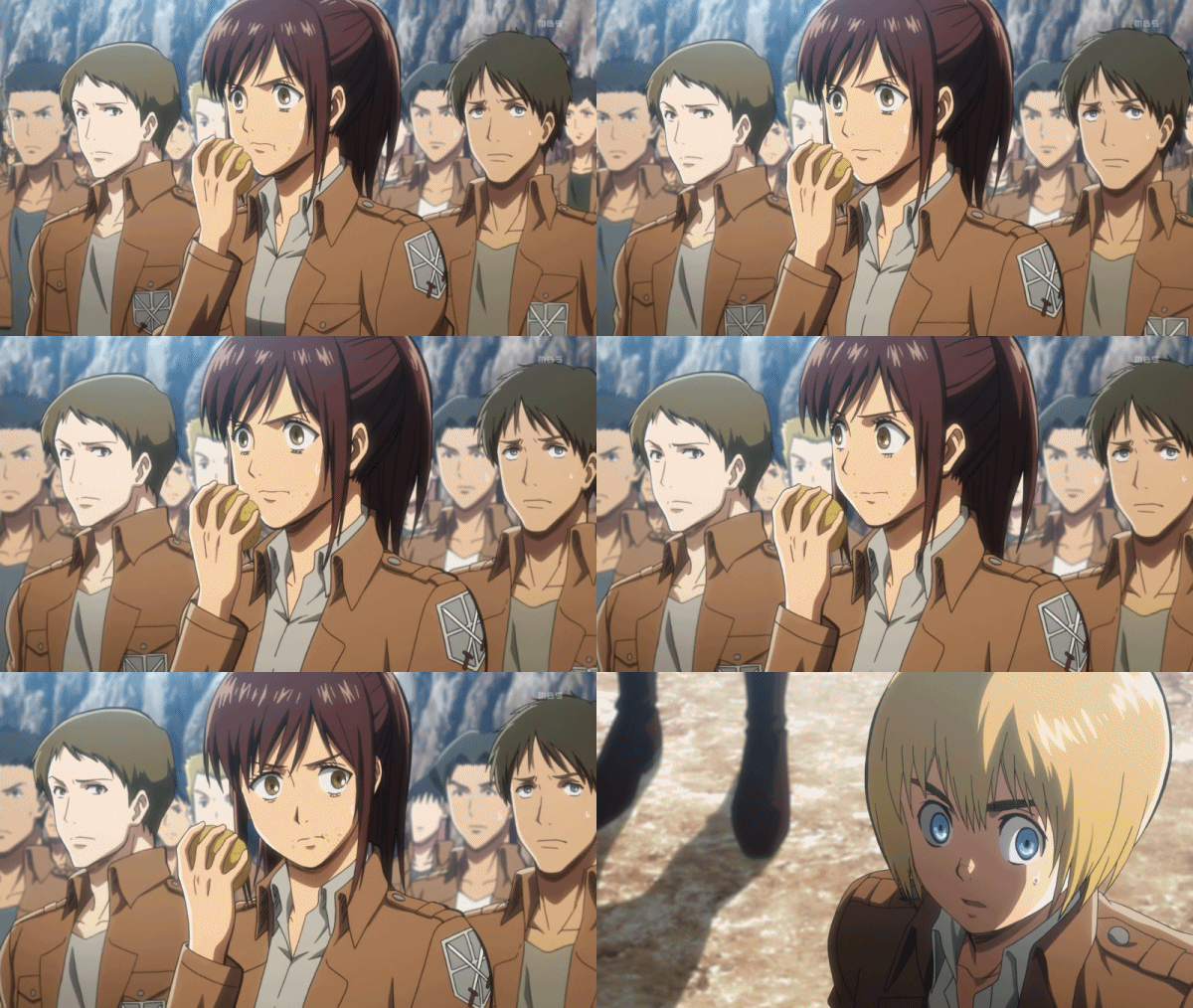
"Attack on Titan" sucks too.

______________________________
            If you like or hate this please take the time to comment, +1, share on Twitter (click that link to follow me), Tumblr, or Facebook, and otherwise distribute my opinion to the world.  I would appreciate it.

Sunday, July 29, 2018

Audible Review, "Year One" by Nora Roberts


As you might be able to tell from previous blogs, I have an Audible account.  Listening to audio books is the chief reason I have been able to introduce myself to so many books while at the same time being able to go on long walks to drop weight.

It is unsafe to read while walking, don’t do that.

Audible is good at what I would call “Toe Dipping”.  Running sales on books that are the start of a series or gateway titles into an author’s work.  This allows their listeners to dip their toes into a much larger pool of literature to check the temperature.  No need to commit more than a few bucks, but potentially finding something great.

I have taken a few opportunities to try out authors I otherwise wouldn’t.  Most recently it was Nora Roberts.  A woman whose ability to bang out so many books is shocking, and I decided to try her first foray into fantasy, “Year One”.  At least I think it is her first fantasy story, she has written so many books one of them is bound to have a witch or wizard in there just by accident, like how someone you know is almost certainly superstitious about something stupid, but it never comes up and you don’t notice.


Mild Spoilers, but I am not recommending the book, so take that under advisement.  Also, prophecy plays apart in the narrative, if you are paying attention the book spoils itself, which feeds into my central gripe of the book’s lack of tension.

The Plot

After a mysterious bird flu sweeps across the planet killing billions, Magic returns to earth.  Witches, elves, fairies, and other supernatural entities emerge.  How a group of survivors cope with not only an apocalypse but a complete rewriting of how they understand the world serves as the focus of the narrative.

The Good

There are scenes that are effective.  A news station finally broadcasts how bad things really are to the public because the panic is causing mass hysteria… that is an effective way to end the first act.  Traveling thru a subway tunnel that is full of crazy murderous wizards and people who have turned into violent rapists because of the breakdown of society is an effective and atmospheric start to the book’s second act.  No one part of the book is all that bad on its own, it is more about how those parts hang together.

The Bad: Tension

The scenes do not hang together all that well.  Generally, there is little tension to the narrative because not enough information is given to the audience for them to anticipate something happening.  I am reminded of an interview by Alfred Hitchcock about how you can bore an audience by not giving them enough information about how much danger exists in a scene.


This book is full of LONG discussions between characters about things, and those discussions are dull.  There is a tone/theme of, “How strange that we now live off the land after being city dwellers for so long… Isn’t it great?” which is fine, but it gets repetitive, and it is strange to me that there is more awe and personal soul searching about living in a rural setting than there is ABOUT FUCKING MAGIC BEING REAL.

There is also a redundancy to listing traits, I think the books tells us that the main character is a chef like 19 times and it has zero relevance to the story.  She’s a doctor, he was a writer, that guy is into tech, but I rarely get a sense of people beyond their skill sets… and I guess a bunch of them get a love interest, but since the characters rarely if ever have ulterior motives or apprehensions they all seem to be in love because they are attracted by how bland each other are.

In a more interesting story a character might feel conflicted about being in love with someone because they are scared of their magical powers, feel guilty about moving on from a lost loved one, might want to leave the community and want the lover to come with them, and that stuff is almost there, but no… There isn’t even a love triangle, which would be cliché, but at least it would be something.

This meme dead yet?
There are scenes that have tension, violent people are seen, and then are encountered later when the characters are in a weaker and more panicked state, planting and payoff.  It is the arc of the story which is not great at planting things.  At least to me.

Some information is put out there related to how there is a group of dangerous people roaming around, with some descriptions of their attitudes and symbols, but their methodology, where they are or where they are headed, no mini-skirmish with them ever happens.  Some refugees from their violent acts show up, but there is no first-person scene of the bad guys being bad to the characters.  We have a concept of the bad guy army/community, but no visceral encounters.

There is a somewhat effective villain in the form of the Dark Angel like characters that menace the main character and her husband.  They are ostensibly dealt with near the end of the second act in a clever way, it is a good magic battle which utilizes the environment well and there are stakes.  When they show up again it is after no information is given about them still being alive after being “killed” in a fight with the heroes… But, they are so obviously not killed in that fight that I wasn’t surprised, I was just baffled that they showed up again when they did because IT MAKES ZERO SENSE for them to be there in that way.  The inclusion of the Dark Angel characters (I am calling them that, the book just describes them as having wings) works until they come back, then it falls apart.

You do not really feel the looming threats is what I am talking about.  They are there, we know of them, (as readers) we fully expect them to show up eventually because this is a book we are reading, and a confrontation makes sense, but it still feels like they came out of nowhere when they do show up.  Like, “Oh yeah, those guys.”

Tho, abrupt encounters might just be a staple of the genre.

Some More Bad: Character Traits and Act Breaks

To go back to something I mentioned earlier about the main character being a chef, it is not a metaphor for anything, her decision to take along a set of designer chef knives when fleeing the city is not a set up for anything (I expected her to use them as weapons or part of some ritual, nope), and ultimately the chef part is just a character trait that gets referenced a lot but has no bearing on the plot.  When they keep talking about her being a good cook I just don’t care, especially considering her actual role in the story that makes her important has NOTHING TO DO WITH HER SKILLS.
The book also has a weird structure for its acts.
  • ·         Act I is about the plague and ends with the news broadcast about how bad things are.
  • ·         Act II is about getting out of the city and meeting up with various other minor characters ending with the fight with the dark angels.
  • ·         Act III is about the town of “New Hope” a post apocalypse colony and it ends with the whole thing being destroyed (it is cheap when it happens and that more than anything kind of killed the story for me). 
  • ·         There is then an Act IV which feels either like an overlong epilogue or like the first few chapters of another book.  It is about the main character (by virtue of being the last one standing) finding someone to help her after the destruction of New Hope, it ends with the birth of the Messiah (hence the novel’s title “Year One”).
  • ·         Then there is the Epilogue in which a wizard shows up and tells the characters something they already know to set up the sequel.

I am fine with Acts I and II, but the others do not work for me.  III is especially boring and the ending does not feel earned.

Even More Bad: Magic *Yawn*

Lastly, I want to talk about the magic.  Call me a nerd but I like when people spend time explaining their goofy as magic systems like it is some kind of Role Playing Game and you need to know when to drink a mana potion.  I have invented my own magic systems for stories, they are fun.

The magic in this book is vague and boring.  I was expecting it to be a lot weirder, because there is mention of a naked woman riding a unicorn at one point and there is a Fairy supporting character… But it gets real dull real fast.  There is just talk about Dark and Light, and honestly that was simplistic in “Star Wars” which is a space-fantasy aimed at a much younger audience. 

In a book there is no reason not to spend time discussing the implications of magic, how it works, how it makes you feel, but they just keep coming back to light and dark.  “I feel the light within me.”  That is dull.

Paradoxically it is treated like a big deal, but never feels that way, aside from some villainous characters (thin and pathetic characters clearly portrayed as being wrong) nobody really gives a shit about magic, they treat their friend’s ability to fly almost like they got a new bread maker, “That is cool, Fred… I guess.  It is a bit doughy, keep practicing.”  I get no sense of awe, nor any real understanding of the metaphysics at work here.  It is just boring and obtuse.
I am not so subtly making fun of my friends who own a bread maker.
In Summation

I thought this was going to be a mix of Stephen King’s “The Stand” and Jim Butcher’s “Dresden Files”, and that is still my go to comparison, but the characters are not as flawed and interesting as they need to be, the threats don’t feel as oppressive and immediate as they need to, and the philosophy behind the magic is vague and dull.

It is not the worst book I have managed to read all the way thru.  Maybe one day I will get around to writing a blog about Elizabeth Moon’s “Sheepfarmer’s Daughter”.

______________________________
            If you like or hate this please take the time to comment, +1, share on Twitter (click that link to follow me), Tumblr, or Facebook, and otherwise distribute my opinion to the world.  I would appreciate it.

Monday, February 5, 2018

Audible Review, "Michael J. Sullivan"

            This book review was written for “Erikson Presents” a recurring book review series on a Facebook group I frequent called, “The Tavern at the End of the Internet”.  It is a nerdy fucking place.  That being said, here are some of my thoughts on the work of Michael J. Sullivan.

The Author and Their Strengths
            For the last year+ I have been delving into audio books.  I recommend this as a hobby as combining an audiobook with a lot of walking leads to being both well read and much trimmer.  The reason I bring this up has to do with how many authors I have discovered during that time, one of which I will be talking about today with a recommendation.  Michael J. Sullivan, who I would point to as a true success story in the self-publishing market.
            Michael, as he explains in one of the forwards to a series tends to take an interesting position on how to write a fantasy series, he writes the whole thing up front and then edits it for clarity, foreshadowing, and theme as he does the re-write, insuring that the whole thing hangs together better.  The second entry in one of his series was delayed to account for greater clarity to be put in at the behest of his main editor, his wife, and as the rest of the series is released I will see how that banged out.
            Enough about method, let me explain to you why I am recommending Sullivan’s work to you, prospective reader.  And it mostly boils down to two strengths that I feel define what I have read of his work, good dialogue and good group interactions.
            Different authors have different strengths, when I list what I like about JK Rowling or Ray Bradbury I point to the almost melodic quality to their writing.  When I want to tell someone what I like about Dennis E Taylor’s work on “We are Legion (We are Bob)” I point to how thoroughly he explores the premise of the work.  Heinlein is good at philosophizing, Tolkien at mythologizing, and Neil Gaiman at somehow making fairy tale logic feel real and even brutal.  This is not to say that Gaiman can’t write great dialogue (he does) or Tolkien can’t write beautiful prose (he does), but when I want to single out their true virtues that is what I point to.


            Sullivan has great dialogue.  People quip, stammer, affect socioeconomic standing, or betray prejudices thru (what I consider) subtle language usage.  They are also frequently funny.  Two men are lost in the wilderness, hungry and cold, and one of them relays a story about fairy creatures that lure in lost travelers with delicious food and then keep them forever, to which the other rightfully questions why that is something to be feared.  It has a timeless quality and the humor comes from the word play and observations.
            Which leads to the next strength, group interactions.  There are scenes where a half dozen characters are all talking in a room and they all have different points of view, experiences, and goals, and you are able to understand where each are coming from.  The way they address each other, challenge each other, and try not to tip their hand all while enticing, threatening, or tricking each other is clever.  They are fun conversations to read.


The World of “Riyria”
            As of writing this I have read 5 of his novels, the beginning potions of each of his series.  I also read them in a unique order, making me see different hints and foreshadowing in a different light as I went.  For simplicity sake, I will talk about them in the order they are “intended” to be read.
            “The Riyria Revelations”, this is Sullivan’s first series, following the work of two legendary outlaws as they become pawns of a grand conspiracy.  They are framed for murder and must work with a series of colorful characters in a quest to first clear their names and then to unravel the conspiracy as it threatens their friends, livelihood, and you know… The lives of many-many innocent people too.  Riyrie (pronounced Rye-ear-uh) is the elven word for “Two” and is the name of their thieving enterprise.
I do not know who made this fan art, but I like it.
The only source link I can find goes to Goodreads.  If you know this person send them a compliment.
“The Riyria Chronicles” is a prequel series, showing the various adventures that Riyria went on to become legendary outlaws.  These novels are a paradox for me.  They are all standalone adventures, but they are also filling in blanks in the personal mythology of the heroes and their supporting cast, so at the end of the first book, I guess I was supposed to say, “Oh, so that is how that all went down” but (as I read the first book in this series before reading “Revelations”) I ended up just saying, “Wait, what?  Why did it just stop?”  This is most sequel-prequel series I have ever experienced.
“The First Empire” is a prequel to the other books in much the same way 3000Bce Ancient Egypt is a prequel to 1990 Desert Storm.  This series takes place in the mythologized past and shows how humanity moved from a disparate group of stone age tribes to an iron age empire battling the dominate Elf Empire and coming out on top thru the rather brutal strategy of “Keep fighting, we’ll choke their rivers with our dead I we have to!” Zerg Rush.  This is the first series I started with and aside from certain characters in this book being the people important places are named after in the Riyria stories, Alexandria style, this might as well be a standalone series.

Some Weaknesses
You might be asking now, “Well, what is the bad side of these stories?”  I am not one to shy away from offering criticism even to authors whose work I love and respect, so here are a couple.
I think that the foreshadowing can be a bit much.  You see twists and Revelations coming from too far off in the distance.  Not a bad thing really, you are following the key characters closely and hear much of what they are thinking, feeling, and remembering.  If something doesn’t surprise them then it shouldn’t surprise the audience.
Sometimes plot development happens too fast and is then resolved too quickly and neatly.  The most egregious of these happens in the second half of book two in “The Riyria Revelations”.  A creepy, violent, inquisitor has suspicions about one of the heroes and plans to get him lynched by revealing this information.  The villain decides to make a pact with a witch doctor to accomplish this.  Now in most stories this dark pact would be hanging out in the background, always just on the edge of springing.  It is the ticking clock, Sword of Damocles, (third literary term) that keeps tension in the story.  When is it resolved?  The next chapter, in like 10 pages.  Shrug.
The last issue might be the world building.  While I don’t have any issue with it, Sullivan does jumble some elements from history that lead to a somewhat patchwork appearance.  Some kingdoms look like Skyrim, others like London just before the Industrial Revolution, and others have the feel of Renaissance era Italian City States.  This is fine for me, I like juxtaposition of elements (same reason I like Conan stories) but other people might find the clashes jarring.
I will however indulge my PETTIEST complaint ever right here, in book two of “The First Empire” one of the subplots involves the creation of the first writing system.  That is an interesting story to tell.  HOWEVER, at one point a character uses the phrase “this underscores” to provide emphasis.
What is the issue?  “Underscore” means to underline something.  A society that does not have writing would not use that phrase.  That being said I invented my own head canon to explain this discrepancy.  In this underscore refers to scoring the sole of a shoe or boot to give it traction.  That makes enough sense to fit as a metaphor to turn colloquial.  Fight me.
(No joke, I actually sent Sullivan a fan e-mail explaining this issue and this solution to it.  I think that is the only time I have actually sent fan mail to an author.  I really hope I didn’t hallucinate that use of the phrase.)

In Conclusion
Okay, that is my recommendation, I hope that if you like fantasy that emphasizes good dialogue between groups of colorful characters you will consider reading this one.  If you have Audible, my preferred method of consuming books now, then the narrator is Tim Gerard Reynolds.  I consider him a gifted voice actor and he grants a distinctiveness and mood to each of the characters, his Royce Melbourne (the cynical rogue) sounds different from Hadrian Blackwater (the dashing swordsman).  His versatility is appreciated for those scenes with lots of characters.
If you would like to try out a story for free on Audible, here is “Professional Integrity” which is a clever little (1 hour and 20 minutes) story staring Hadrian and Royce, the two main heroes of the whole thing.  And here is another one called “The Jester” which is basically 1 clever trap room in a Dungeons and Dragons game turned into a story, I loved the cute little moral to the whole thing.
I hope you enjoy your reading.


______________________________

            If you like or hate this please take the time to comment, +1, share on Twitter (click that link to follow me), Tumblr, or Facebook, and otherwise distribute my opinion to the world.  I would appreciate it.

Wednesday, September 6, 2017

Audible Review, "The Cold Dish"

Been A While Since One of These
            Recently, that is to say 4 weeks ago, I bought a daily deal on Audible.  This was “The Cold Dish” first of the “Longmire” series of Mystery/Western novels set in the rural areas of Wyoming, in this instance dealing with the interactions between the white community and the Cheyenne Indians native to the area kept on the nearby reservation.  This series has served as the inspiration/template for a TV show and it is on Netflix.
            Overall, I did not enjoy the book.  Nor did I enjoy the performance of the book.  I can see how this story would work better as a TV show as there are LONG periods in which things are described, having that as a visual, with actors moving and struggling would be more entertaining.  At it is in the book, there are times when paragraph after paragraph goes on and boiling it down amounts to, “I got lost in the snow”.  I have not watched the show and cannot speak to its quality, but I am going to log a big complaint for this book.  The mystery element to the story is WEAK.
 
The show does appear to be well cast and I imagine it is well produced, at least since Netflix picked up production.
How Mysteries Work
            Forgive me if this does not need explaining to you, but I want to define my terms before moving forward.  The key/core appeal of a mystery story is watching it get solved.  The reader/viewer is shown all of the clues, all the suspects, and the main character takes those pieces, and presents something about them that provides greater insight than the reader could be expected to get on their own.
            For instance, Sherlock Holmes being able to determine the approximate height of a person by where they wrote a message on a wall, or being able to see that the word “Rache” is not an incomplete “Rachel” but in fact the German word “Rache”.  The point of a mystery is for it to be solved via insight into the suspects prompted by the correlation of clues.  It is mental triangulation. 
            With all that in mind, imagine my disappointment when I managed to figure out who the killer was not by seeing clues in the story, but because SO MUCH TIME is spent exploring the character/perpetrator in the course of the narrative that I assumed the only reason so much of it was included was that ultimately the character had to be the killer.
            At first I was trying to give the book credit.  That maybe this was going to be a character that would serve to anchor the protagonist, or explore something about his character, or maybe just provide some key insight later on.  You know the type, you’ve seen it on “House MD” when he talks to a walk-in patient in the clinic and solving their problem gives him insight to solve the “real” case for the episode.  I figured this character could be one of those.
            You don’t include someone in the plot to this level unless they matter, ESPECIALLY when their inclusion is such a boring subplot.  Unfortunately, after listening for 5 hours of a 14 hour story the character all but vanishes and I couldn't think of why their scenes would be in the book unless they were the killer.

Voice Work
            Let’s talk about something not directly related to the story.  The narrator, George Guidall fits the character of Longmire perfectly.  His voice is old, craggy, and feels like someone who has lived in the world of the narrative.  He is perhaps a good fit for the book beyond that, as the story is mostly older sounding guys, but George reads it SO SLOWLY.  Listening felt 4 hours longer than what it was, and I listen to my books at x1.1 speed.
            To put in perspective how long it took me to get thru this book, after about 6.5 hours of listening to “Cold Dish” another book I wanted to listen to more, “All These Worlds” came out and I snapped it up.  I listened to the entire 8-hour “All These Worlds” in 4 days, and then swayed back to this one out of a sense of… Obligation?  I guess.

I feel like I should give a complete review of this series.
I kind of loved it, and it juxtaposes perfectly with a recent more successful book that I hate.
            A book that feels faster and more alive, that I can listen thru in a 1/4th or 1/3rd the amount of time I took on this story.  “Cold Dish” does not grab the reader.
            Almost all of my “reading” these days is done via audio books.  I am trying to get more in shape and the best way to do that is to go on long walks, and the best way to make those walks tolerable is to listen to a story.  I have listened to maybe 15-20 voices reading stories at this point and I know what I like.  If this sort of thing does not bother you, then feel free to disregard this criticism.

Backpedaling
            “The Cold Dish” is not nothing.  There are things to like, the characters talking about spiritualism, the history of the area, the folksy charm of a small town, and the challenges that comes with trying to go out into a hostile wilderness investigating murder.  Even the forensic aspects of the story are good even though I think the deluge of forensic programs that came out when I was younger demystified a lot of its charm.
            There are good things and good characters in the book, but god damn was it too long and the case was solved not by interesting clues aligning, but by me just being up on conventions of the genre.  That is weak.  That is fatally weak.
            I cannot imagine someone who has read numerous mysteries getting anything out of this story unless they prefer character drama to investigative aspects.  MAYBE you prefer the types of stories that are about the CHARACTERS and there is a mystery, rather than a story about characters solving a MYSTERY.  It is a matter of emphasis and taste, but for me this did not work.

Random Confusing Element
            Also, Indian Magic is real in this book's universe?  That seems to be more explicit than I expected.  There are ghosts.  They are alluded to in several scenes that make them more fact than hallucination/delusion.  I don’t know how to feel about that.


            Overall, I give it a 2/5.
______________________________
            If you like or hate this please take the time to comment, +1, share on Twitter (click that link to follow me), Tumblr, or Facebook, and otherwise distribute my opinion to the world.  I would appreciate it.