Friday, July 12, 2013

Incongruous Soundtrack

            Music plays a huge part it what we perceive on screen in movies and television.  Shows have blamed various drops in quality on the loss of good music direction/production ("Star Trek: The Next Generation" is the example I can think of, dropping a talented musical presence just as the rest of the show was shifting into gear).  This is a tool I think can be used in other ways though.

            Prevalent in theaters there are a lot of remakes and adaptations of older movies and books, but these productions lack an identity of their own because they are just doing what was done before with slightly better special effects or lighting budgets.  I actually think that one of the stronger ways a movie can distinguish itself is through a drastic change in the anticipated musical choices to accompany the scenes.  The best example currently would probably be "The Great Gatsby" released last month.

            I do not care for the book of this story, I find it to be well written, but the subject matter and the characters are just so spit inducing bad that I can't muscle through it.  This movie has those same issues, but it does something to distract you: music.  By putting in a soundtrack that is not just another 1920's production the film wakes the audience up and invites comparison to other things.  Rap music in the modern day based upon singing about drug dealing and casual misogyny evolving into an industry that sings about being rich and how awesome it is.  This is juxtaposed against a world of rich, misogynistic assholes who are miserable, and one of them got his money from alcohol distribution during prohibition.

"How about we don't make just another forgettable remake?" -Luhrmann
            All of that aside it gives you something else.  "The Great Gatsby" has a look, a feel, expectations, and a lot of previous iterations that were the book.  The Robert Redford film from ages back is a bland and joyless movie with no sting or identity beyond being an adaptation of the novel... basically beat for beat.  But the modern Baz Luhrmann directed version has an authorial stamp that distinguishes it in the minds of people.

            Luhrmann's "Gatsby" will be remembered for sucking, but so will its unique presentation.  This style was applied to the director's other period pieces, "Romeo + Juliet" which took the dialogue of the original play and set it into the modern world, and "Moulin Rouge" which took a period setting but with modern music adapted into it, taking typical troupes and a lot of music people knew but presenting them differently enough to grant the work a memorable (albeit kind of shit) collective whole.

            If I could make another example, "A Knight's Tale" directed by Brian Helgeland takes a story from "Canterbury Tales" and adds a rock soundtrack... to great effect.  It shows how sport was a popular thing and instantly draws your mind to the music the stadium plays during lulls in a game to keep the crowd up and interested.  It is granting you a perspective and identifiable mentality to the audiences in the movie.  It is drawing you into a film that is at its core very cliché.

Though I imagine the reasons people saw this movie might vary.
            This sort of thing is sorely missed in a lot of movies that really needed it.  "Troy" was a god awful film starring a huge cast, tons of costuming, huge numbers of extras, and fight scenes that were really cool.  The dialogue and music did nothing.
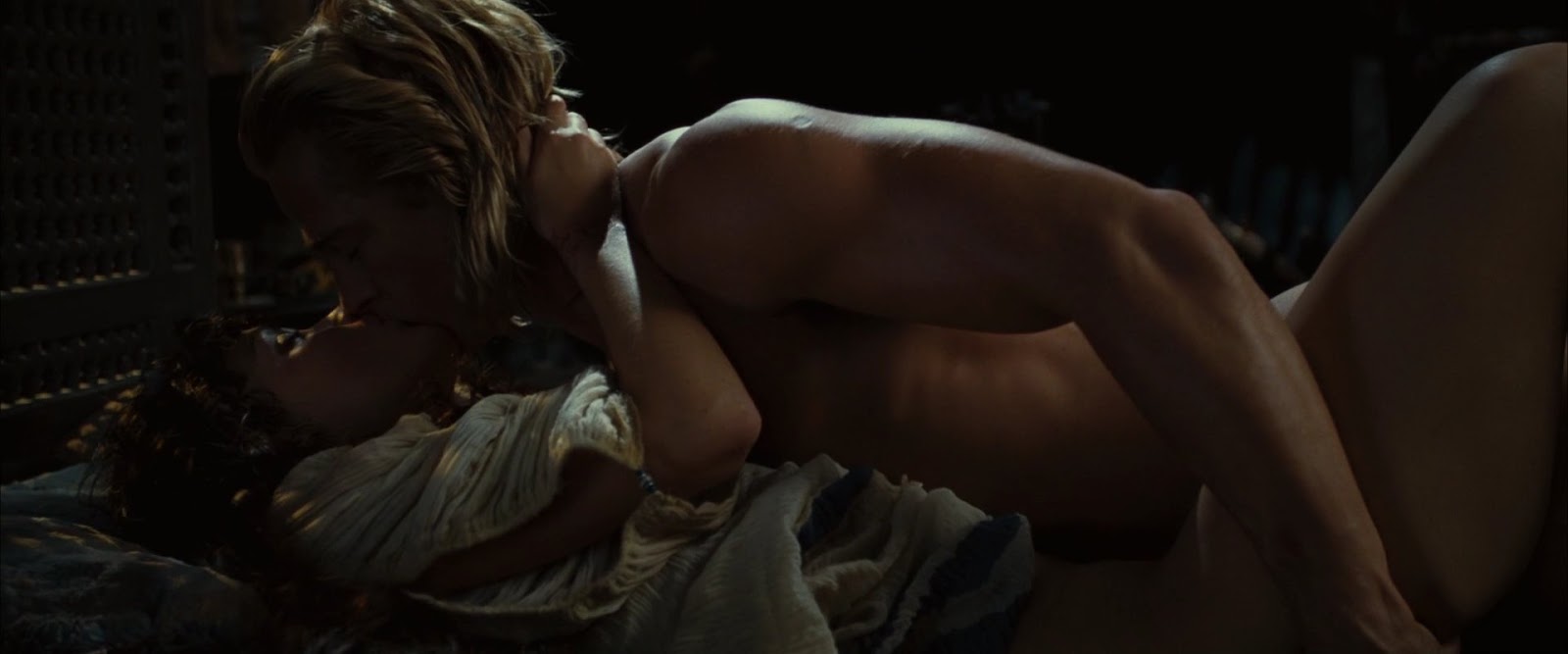
Though I imagine that the reasons people saw this movie might vary.
            "Troy" did try to change its source material up, changing a story involving very active gods and magic and making it very terrestrial, but did nothing to fix the real problems of Homer's "Iliad" (the story this all turns on).  The real problem is that the work was translated very literally by people who have no ear for normal people.  The movie has speech that is stilted to the point of being unbearable; terribly clunky and formal.  People in ancient Greece did not talk in formal English, soldiers in that time spoke the equivalent of soldiers today, like regular people in a stressful situation far from home.  People going to a theater want to watch a movie that sounds legitimate, not like it is out of time.  One might say that the movie, "The Immortals" (while visually and story wise being balls to the wall insane) is vastly easier to watch and be taken in by because the characters sound like people.

Though I imagine that the reasons people saw this movie might vary.
            Imagine a movie in which you saw warfare in the Classical Age via dialogue and music that elicited the feel of a war movie set in World War II or Vietnam?  Playing "The Ride of the Valkyries", "The End" by the Doors, or "Ohio" by Neil Young.  The juxtaposition of music between modern war and classic war might make the audience think about how the people at war in "Troy" were just like those kids who went to war in our own time, and that the greed of kings like Agamemnon is a thing that is as old as history and is STILL AROUND.  Then you could loosen up the words to have them flow naturally instead of like they are being written by a Professor of Classical Literature who is masturbating to the thought of Homer blindly reciting this all to a group of Greek Aristocrats.


            For other examples of music working with genre to make something unique isn't hard, and I think it is going to be done more and more as directors and producers have to try to express their own creative interests in a movie world that will only let them do so via adaptation.  "Firefly" was a science fiction show with western music and themes, "Cowboy Bebop" was jazz science fiction, and "Samurai Champloo" was Samurai hip hop, all of these were original properties with a blending of music and themes, while "Scott Pilgrim Versus the World" was indie rock Superhero, an adapted work which took a lot of the source material and (I think) elevated it with music you can actually hear (I have no idea how some authors have the audacity to produce comic books about music the reader cannot hear).


(This is the gayest blog post I have ever done...)

Wednesday, July 3, 2013

"Man of Steel" vs "Star Trek Into Darkness"

            Two of the biggest movies that came out this year, and two that I liked, were "Man of Steel" the start of a new Superman franchise as a creative collaboration of David S Goyer, Christopher Nolan, and Zack Snyder; and "Star Trek Into Darkness" which is a project by JJ Abrams and Damon Lindelof (I think, I am cutting out several writers, but this script has a Lindelof-ish taste that I can't shake).

            The movies sort of parallel each other in some ways, a collection of 50+ year old science fiction characters battling against an evil mastermind in a gigantic spaceship, that villain kills a father/father-figure of the protagonist, and ultimately the movie ends with a knock down drag out fight in a major metropolitan area devastated by the conflict.  Both have large ensemble casts and play with big ideas ("Steel" deals with "Eugenics, conspicuous-consumption of natural resources, stagnation of societal evolution, militarized-revolution begetting fascism and abandonment of outward-looking intellectual curiosity" -Moviebob, while "Trek" deals with Eugenics, preemptive war, drone strikes, and the socio-political ramifications of its own interstellar navy: Starfleet).  The point is I think that neither completely realizes the ideas they are shooting for, but for two entirely different reasons.
            "Steel" doesn't fully explore its ideas because it is setting up a franchise that will address them.  Christopher Nolan is big on three act structure, and is very capable of delivering a social essay in the form of a movie.  Since he is producing, and the Warner Bros. studio is pleased with the movie and furthering the franchise in this direction, the ideas that were not fully put to use (because they somehow managed an origin story with a highly complex villain) and did not have time even with the epic length.

            "Trek" fails because it has Lindelof as a creative driver.  Lindelof makes stories that I like to term as "Studded".  Much like a denim jacket with shit tons of glittery bits of metal pressed into it, the ideas and symbols presented in "Trek" are not really a matter of function, but instead of flash.  Things are presented and dropped not because they have value to the story, but because the audience will go "Oh, okay".  That bit of familiarity, that bit of meaning is analogous to seeing the Virgin Mary in a piece of toast, it is meaningful because of what the audience brings to it, not because the toast wanted you to have a religious experience.

Cumberbatch plays a cool character that just keeps getting betrayed, to the point where he is far more sympathetic than he really should be.  Actually, he kinda has a Jesus thing going on because he has blood that can heal you if you get it transmitted to you.
            Now I do not want to blame JJ Abrams for why "Trek" fell short.  He is not a "Trek" fan he is merely a mind-blowing-ly competent director of visuals, pacing, action, and acting.  JJ can't be expected to delve into the mythos and make sure to draw a clear line between well developed story with homage to classic stuff, and functional story studded with references to instill the material with associative weight and strength, that is the writer's job... THEIR ONLY JOB on a "Star Trek" movie, or any movie with an established lore.

            To go back to "Steel" almost all of the ideas hinted at and introduced have appeared in the comics and cartoons.  But at the same time they picked very specific aspects to focus on.  Superman's world is a rich science fiction universe to draw on, with god like aliens, doomed civilizations at their zenith, and the perils of scientific rationality taken to dangerous extremes for any number of reasons that are unethical.  "Steel" is the introductory paragraph to a bigger message using the familiar aspects and iconography of Superman to explain and explore the issues, it is actually only held back by a lot of movie conventions.  You know what character didn't really need to be in the movie?  Lois Lane and the entire Daily Planet crew.  I like them well enough, they are well cast and promise to hold their own in future movies, but pretty much nothing in this has anything to do with them needing to be there, and number of characters could have served Lois' role in the story, and done it better (I am looking at Richard Schiff who played the underused Dr. Hamilton, he could have followed Superman into the ice cave to find the Kryptonian ship, he could have asked to be brought along to Zod's ship when Superman is taken up, he could have talked with Jor-El and worked to modify Clark's Ship into the weapon used against the Kryptonians, Lois did not need to be there.  In fact everything she does would have worked better as the cold opener to a second movie, but movie conventions say that you need Lois, you need the love interest for Superman to save... Whatever.)

Shockingly, this Emmy winning actor was cast to play a character I consider to be rather prominent in the Superman universe and is used far too little in this movie.
            Lastly the big difference is the endings, which I won't spoil really.  "Steel" ends more ambiguously, Superman's relationship with the government is murky, his place in the world is still being felt out, and he is left burdened with how the fallout of the movie's events will play out in the future.  "Trek" just sort of ends.  They tie up the loose ends, no lasting effects are felt, there is no indication for what will happen in the future.  Even events set up in the first half of the movie (an impending war with the Klingon Empire) are not mentioned, even though the movie's epilogue is a flash forward to one year after the events of the film proper.  The bad guy gets an unsatisfactory conclusion (in a way it is quite horrifying) and a lot of bad precedent is set, a get out of jail free card that will end up ignored in the future.  I still liked "Trek", it was fun.  But it has issues, and I don't feel they were intended to be followed up on.

Sunday, June 30, 2013

My Thoughts on "Spec Ops: The Line"

            "Spec Ops: The Line" is a video game I had 70% spoiled before I played it, I knew there were going to be instances in which I would face a hard decision and then another, and nothing gets better from that point on.  I heard about the symbolism and the complex nature of the problem.  I heard about depth and how the game goes meta, changing how the player visualizes and experiences what is going on.

Spoilers for this game are sort of everywhere online.
            The art looks good.  Each character suffers degrade from the injuries they have taken, making the damage done to you and the crew very visible reminders of the violence done to an by the player.  The music is classic and evokes that anti-war protest tradition that was not as popular in its heyday as the country has been lead to believe.

            I typically do not play shooters, I know when the controls are a little too loose but while I have been told that "Spec Ops" is not an ideal shooter gameplay experience I liked it a lot, there are very few points in which I felt the gameplay was too difficult or sticky for what I had to work with.  I like that the ammo was not pouring out of every vending machine and that the limited weapon selection meant that I had to work on my aim a bit, a big departure from "Saints Row the Third" which had me spraying bullets like mad to take down any one target.

            Overall this game really delivered, while the gameplay is fun I really appreciated the dark subject matter and the condemnation of war and the glorification of war that has become so prevalent in our culture.  Violence has weight.  Violence has visible effect.  Shit goes down.

            If you haven't played this and you have any disposition to play a violent game that ridicules violent games it is shockingly cheap to pick up and well worth the time to play.  I would go so far as to make sure you play it first, then watch the videos I linked to in my first paragraph to make sure you get everything you can out of it.
  
Also, gorgeous setting in Dubai.

Saturday, June 29, 2013

My Thoughts on "Superman vs. The Elite"


            This is a fun movie with a clever philosophy clash that elevates it above most action pieces.  In it Superman is confronted by a team of young superheroes who grew up idolizing him.  At first Superman works with them, helping to lead and educate them on how to handle disastrous situations.  After several encounters a difference of methodology begins to take shape.  Superman, being them most powerful hero on Earth does not kill human opponents, he does not think he has the moral authority to do so being that he is an alien at that if he did, then he would just be a tyrant rather than a good Samaritan.  The Elite do not have such restrictions on themselves.  They see terrorists and dictators and violent criminals as targets for violent dispatching.  When the Elite begin pushing this further and further Superman tries to stop them and ends up in a full on showdown.

The movie is based on this comic from the 90's, which in turn was written as a reaction to the very adult "The Authority"
            This is one of the best Bruce Timm animated productions made since the end of the Justice League series, the animation has a modified style, the characters each have their own look and distinct abilities allowing for very diverse and easy to follow action.  The voice acting hits the same super high standard all of the productions reach, and most importantly it does try to have the discussion of whether might makes right.  And I really think it holds together right up until the final confrontation and the resolution.

            I did not really get what prompted the Elite to have a showdown in Metropolis.  They could have just said, "Superman, we respect you a great deal, and if you want to go on saving lives and averting disasters, please do.  But we are not as powerful as you, we feel we have to get down and dirty in order to force the world to be better.  If you don't agree that is fine, but if you try and stop us, you will actually be helping terrorists and third world dictators to continue their crimes against humanity.  Even if you think our measures are extreme, you should just step aside.  If you think we are about to turn into the monsters that we hunt, then go ahead and stop us, but right now all we have done is taken out permanently those who were definitively and demonstrably evil."

            What spurs the main conflict in the movie is a war between two countries, both of which have been developing super weapons (giant bug monsters and ray guns) instead of developing their countries' infrastructure.  They go to war and the civilian casualties are so horrific Superman steps in to try and halt the violence.  Superman is nearly killed by the highly advanced weapons and the Elite save him by killing a large number of troops (who had it coming, seriously they tried to kill Superman).  The Elite get admonished by Kal-El but then go beyond that, the Elite attack and kill the leadership of both countries and force peaceful capitulation.  Superman is horrified, but the world looks up to the Elite for the actions they took.  Then for no real reason, the Elite and Superman decide to fight each other to prove who is right.

            And, up until they started fighting Superman for no real reason, the Elite were right with what they were doing.  You don't win wars through delaying action and hoping for peace talks, you typically win by inflicting a measure of harm that keeps the other side from continuing, and in this instance neither side could do that without costing millions of people their lives.

            The battle is actually really cool too, they teleport to and from the moon, cars are flying, Superman appears to go crazy and start killing all the Elite.  Truth is Superman was illustrating his point, the whole battle was a big publicity stunt in a way.  Superman had complete control of the situation the whole time, with robots and fail safes so that it could appear that he was killing the Elite and disregarding the safety of the public so he could show the world of a superhero just using his powers to dominate (ruthlessly protect) the world rather than just trying to be helpful.  Unfortunately Superman's reasoning is wrong.

He goes a little nuts.
            Superman ultimately only wins the argument because he is so powerful that he can prove his point without actually killing anybody, and that is a luxury that no one else has.  I understand his reasoning, that in general "might makes right" is a poor philosophy that the Elite are perpetuating, but even Superman has met beings he would willingly kill:  Darksied, Brainiac, and General Zod are all examples of that.  Hell, in Superman/Batman #5 Batman nearly talks Clark into vaporizing Luthor in the Oval Office.  In other words, might makes right is still the philosophy at work, its just a more soft power approach than what the Elite ascribed to.

            There is also another point: Superman takes away the Elite's powers at the end of the movie.  I also very much disagree with Superman taking away the Elite's powers.  There was no trial for their actions.  Superman just decides to take their powers.  That isn't okay by his own logic.  That is the same as the government taking away people's freedom to travel or work certain jobs without trial.

            What is more, the movie kind of knows that Superman is wrong, and goes out of its way to show the Elite as all very Hedonistic loose canons.  One of the team members drinks too much, another is a jealous and temperamental, another is very lusty.  The team leader, Manchester is portrayed very unevenly.  As a child Manchester was homeless and lived with his little sister under a bridge and stole to survive, when one day they are caught by the police and his sister falls into the path of an oncoming train Manchester uses his powers for the first time to stop the train from killing his sister.  The accidental catastrophe which follows is tragic and really informs the character, who lies to Superman telling him what happened, but not that people were killed on the train by the untrained force of Manchester's powers.  In context of trying to save his sister those actions are justifiable, but are shown in the movie as indicative of future villainy, which is really unfair considering he is a child at the time, and probably only told Superman the lie because he was ashamed of what happened.

            So, yeah... Good movie, I liked it alot, but its message gets really foggy toward the end as it continued to shave of the depth and complexity of the argument in favor of a very paternalistic Superman being right because he is so powerful you can't disagree with him.  I give it a 7 out of 10.

(This review was spurned into existence mostly in reaction to this video, by Solkir, on the Agony Booth)

Tuesday, June 25, 2013

Sleeping Medication

            (I wrote this when I first started taking Ambien to help with my lifelong inability to fall asleep in a timely and restful manner, it most definitely changed my life for the better and if you have problems falling asleep go get medication.  Sleep is one of the most important things in your life to finding happiness, productivity, and is itself one of life's great pleasures.  That being said, taking a new drug, even one that is considered kind of 'meh' as far as side effects are concerned I was caught in between a pill helping me want to go to sleep and my natural mindset which vastly prefers sleeping from 4am to noon.  So things got surreal.)
____________________________________________________________________
            You want an experience?  Take sleeping pills as prescribed.

            I doubt that this is what stoners think of as "High".  If I had to describe the loopy and sticky world my mind takes affection to manipulating that I would call it "In".  Not "High".  Just "In".

            Your dreams start to appear in flashes around you but the real issue is that your keyboard buttons start to feel like soap, then like scrabble tiles without the charm of once being living wood.

            Vision goes too.  Images goo together then the halos of light that everyone seems the see and doesn't see fit to mention.  Like each person is half of Jacob's Ladder that needs someone to share the coiling (sometimes almost fiery) electrical field that appears between them.  An energy unknown, unseen, and undiscussed.

            When you take sleep medication you are outside your mind, but starting to dream... Just know that when you do decide to go back in, be careful of what follows you back in, those things will follow you the rest of the night. 


            Things with painted faces that speak in clicks.

Wednesday, June 19, 2013

My Thoughts on "Red Dead Redemption", End

(Continued from Part 3...)

Cause Avenging an Asshole is Cathartic
            You are now playing as John's son, who much like the dead uncle is a boring and annoying character who is defined mostly as being a wimp and a fool.  The game fast forwards to him being a weary and angry adult.  John's wife then dies off camera years after John's death, and the Son now goes out for vengeance.
            The Son finds and murders the Government Agent which tasked John with finding the gang.  The government agent who ultimately betrayed and killed John.  Here is the problem: that agent was totally right in what he did and was acting with legal authority.
            The Son is just a murderer, plain and simple.  This is not a good message to go out on.  It is basically saying that Justice is a lie and that violence is the ultimate authority.  If the Son had instead talked with and ultimately forgiven the Agent for doing what he did, in so doing bringing an end to the cycle of violence then the ending would have been more hopeful though sad and hard.  Instead the game wraps on the weakest and darkest of all three possible endings.
 
Also, the Son is just not as interesting.
Final Thoughts
            I don't really like this game, and by the end felt like I was doing a chore.  It doesn't help that Redemption is incredibly long and linear.  Its length is not in gameplay either but in padded world crossing.  You will ride a horse for hours and hours from one map marker to the next and deciding which to do first or last will have little if any impact on how the story unfolds.  It is spread so wide and thin.
            You have a series of missions which run you across vast empty expanses on a slow moving horse, back and forth.  Once you finish the missions in an area you are shuffled to a new area, in which you go back and forth completing missions, going from place to place on a slow moving horse.  At a point I just wanted to go from mission to mission and finish the game, I dreaded having to cross the Mexican desert AGAIN, for the sake of doing a mission that I thought was stupid to help a group of people I disliked on what seemed like an entirely unnecessary side quest.
            Here is a crazy thought, why didn't they just have three protagonists.  John hunts Bill.  Another guy (there is a perfect candidate for this in the game too, a retired gunfighter who teaches John how to perfect his quick draw technique, an event which happens so far into the game it is insulting) fights the Mexican Revolution.  And a third guy is a government agent (again, there are candidates in the game) fights Dutch and the Indians.  You wouldn't have to shoehorn in John into a bunch of places he has no business being, and he doesn't have to interact with people he has no business suffering.
            I imagine this thought occurred to Rockstar studios, the makers of the game.  Their latest soon to be out game, "Grand Theft Auto V" has three different protagonists in it, with stories that weave in and out of each other.  That sounds like a good fix.

 
Also driving through a city is just more interesting than riding a horse through a desert.

Sunday, June 16, 2013

My Thoughts on "Red Dead Redemption", pt3


Viva!
            Anyway, at the end of the Mexican Revolution you capture Javier, kill Bill, and help the revolution win at the expense of itself.  Hooray for John.  You are then told the leader of your gang has shown up and you need to get him if you want to go back to your family.  And this is the part when I started hating John.  The Government officials who are forcing him to do this are completely in the right, and John is a monster.
            John is a mass murderer and criminal.  Regardless of his current motivation and whatever else he has done since his days of younger-man-violence doesn't make up for what he has done.  What is more it isn't just me saying that.  Satan (the literal Satan) tells John as much.  But the government agents are sticks in the mud and douches so you as the player are not supposed to like them.  I guess?
            So you head out to catch the leader of your old gang, Dutch.  You have numerous opportunities to do so, are given hosts of reasons to do so, but for some goddamn reason John doesn't.  John has been shown as able to shoot the wings off a fly but can't bring himself to shoot a mass murderer like Dutch even when Dutch blows an innocent woman's head off in front of John.
            Turns out Dutch is some sort of anarchic primitivist marauder, justifying his violence by allying himself with Indians who had their land taken away.  You are shown to be on the side of assholes when they have John escort and assist a racist, drug abusing, Yale phrenology professor around.  Because civilization is clearly the breeder of limp wristed assholes, not like the frontier, which breed real (murderous) men like John.  This message is stupid, and turns a middle finger up at the player who has grown up in the relative comfort and luxury of civilization.  I resent this.
Mostly because both I, and the game itself are products of this civilization.

            Ultimately the end(s) of the game is unquestionably what I have the most problems with.  After Dutch is dead John is allowed to return to his family.  In an ideal happy ending John would ride up to his house, the camera would pan far back and you would watch him walk into his home and the credits would roll.  The journey would be at an end.  The message being that monsters like John get to live and be happy so long as they are monsters for the civilization they would otherwise be a terror to.  It is a complex and damning message to society that glorifies violence with happy endings.  It keeps going.
            Much like the assault on the Fort in Act I, this ending does not happen.  Instead you meet John's wife, uncle, son, and dog.  You do boring missions like killing birds before they eat your corn, herding cattle, and hunting caribou.  Wonderful.  I will admit that I like the character of the wife.  She is flawed and sassy.  There was some legitimate heart put into the writing and performance of the character.
            Then the next ending happens.  Turns out the government are not going to let John go.  He has killed too many people to not face justice.  An army attacks your farm.  This only adds to the game vs story issues because I have a pardon letter in my inventory which would absolve me of any unlawful murder or massacre I might have committed during the game.  This game mechanic can get me out of a $10,000 bounty for the burning of a nunnery, orphanage, and village of retired veterinarians, but it does not function in this scripted event.
            Anyway... there is a shoot out.  John's uncle dies, I think this is supposed to make you sad, I did not like the character so it got a "meh" from me.  John's wife and son escape on horseback.  And ultimately John is gunned down by about half a million rounds of ammunition.  This is again a section which demands the credits should roll.
            Your character has died.  The message of the game is one of justice unyielding.  You cannot escape the wages of sin.  Second chances won't be earned in a civilized society.  Bit of a downer message but I would have been okay with that.  THEN THE GAME KEEPS GOING.


Also, he's been in worse situations in the game, another scenario in which the story and the gameplay are at odds.
(Continued in the End...)